




How Many Watts Does RV Refrigerator Use Per Day?

When living in an RV, embarking on weekend car-camping expeditions, or constructing off-grid systems, a critical question always arises: What is the daily energy consumption of a refrigerator in watts?
This calculation is significant because your refrigerator is one of the few appliances that operate continuously, making it a substantial contributor to your total energy usage. Whether your objective is to reduce electricity costs at home or to ensure that your portable power station, solar setup, or battery system can reliably support your fridge, understanding its exact wattage is essential.
Let's examine the energy consumption of refrigerators, focusing specifically on highly efficient 12V portable refrigerators like those offered by BougeRV. You will also learn how to calculate daily watt-hour usage, compare energy efficiency, and choose the best low-power refrigerator for your unique off-grid needs.
Watts vs. Watt-Hours vs. Amp-Hours
Understanding these terms is key to sizing your power system correctly:
-
Watts (W) = Instantaneous power draw (like a speedometer reading your current speed).
-
Watt-hours (Wh) = Energy used over time. Example: A 50W appliance running for 10 hours uses 500Wh (50W × 10h = 500Wh).
-
For 12-volt systems: Amp-hours (Ah) × Volts = Wh. So, at 12V: Ah = Wh ÷ 12. (E.g., 360Wh ÷ 12V = 30Ah).
-
Use this basic formula for calculations:
✔ Daily Wh = Average running watts × hours running per day (or × duty cycle × 24)
A fridge’s compressor does not run nonstop. Instead, it cycles on and off depending on the internal temperature and the ambient conditions (known as the duty cycle). That is why calculating watt-hours gives a much more accurate picture of daily energy consumption than simply looking at the running watts listed on the spec sheet.
Real-Life Examples Using Visual Illustrations
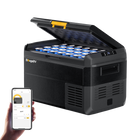
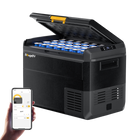
BougeRV’s 12V portable fridge lineup lists the running wattages for their models. For example, the CR Series (BougeRV 12V 30 Quart (28L) Portable Car Fridge) draws 36W in ECO mode and 45W in MAX mode.

Let’s convert those into daily Wh using two realistic duty-cycle scenarios (ranging from the worst-case to the most efficient):
Example A: BougeRV 12V 30 Quart (28 L) (Eco Mode = 36W)
-
Compressor runs continuously (100% duty cycle): 36W × 24 h = 864Wh/day (Worst-case scenario).
-
Runs 50% of the day (moderate conditions): 36W × 24 h × 0.5 = 432Wh/day.
-
Runs 25% of the day (cooler conditions / efficient cycling): 36W × 24 h × 0.25 = 216Wh/day.
Example B: Same Model (Max Mode = 45W)
-
100% duty: 45W × 24 h = 1,080 Wh/day.
-
50% duty: 45W × 24 h ×0.5 = 540Wh/day.
-
25% duty: 45W × 24 h × 0.25 = 270Wh/day.=
All 12V Fridge Series Daily Consumption Estimates
|
Series |
Eco Mode |
Max Mode |
100% Duty Cycle (E/M) |
50% Duty Cycle (E/M) |
25% Duty Cycle (E/M) |
|
CR (30 qt.) |
36W |
45W |
864Wh / 1080Wh |
432Wh / 540Wh |
216Wh / 270Wh |
|
CR PRO (21 qt.) |
36W |
45W |
864Wh / 1080Wh |
432Wh / 540Wh |
216Wh / 270Wh |
|
CRH (19 qt.) |
/ |
45W |
1080Wh |
540Wh |
270Wh |
|
CRS (42 qt.) |
45W |
60W |
1080Wh / 1440Wh |
540Wh / 720Wh |
270Wh / 360Wh |
|
CRD2 (43 qt.) |
40W |
55W |
960Wh / 1320Wh |
480Wh / 660Wh |
240Wh / 330Wh |
|
Rocky (41 qt.) |
45W |
60W |
1080Wh / 1440Wh |
540Wh / 720Wh |
270Wh / 360Wh |
|
E (42 qt.) |
45W |
60W |
1080Wh / 1440Wh |
540Wh / 720Wh |
270Wh / 360Wh |
Why is There Such a Wide Range in Daily Energy Use
A refrigerator’s daily Wh depends entirely on several variables:
-
Rated Running Wattage: The compressor’s typical draw and brief start-up surge s much higher.
-
Duty Cycle: Hotter ambient temperatures, frequent door openings, or adding warm food all increase how often the compressor runs.
-
Insulation & Design: Better-insulated or dual-zone fridges run their compressors less often.
-
Size & Stock Level: A fuller fridge maintains temperature more efficiently than an empty one.
-
Mode Settings: Using "Eco" or low-power modes significantly lowers the average draw.
Because of these factors, you will always see energy use listed as a range rather than one fixed number.
Why 12V Fridges Use So Little Energy Compared to Household Fridges
Portable 12V fridges are specifically optimized for efficiency in mobile environments:
1. DC compressors are more efficient: Traditional fridges use AC motors that require more power and create more heat. 12V fridges use variable-speed DC compressors, reducing consumption dramatically.
2. Smaller but better insulated: 12V fridges prioritise insulation for harsh outdoor climates, maintaining efficiency even in the heat.
3. Smart temperature control: Most models include Eco mode, which prevents unnecessary cycling.
4. Lower wattage + lower duty cycle = major Wh savings:
-
A typical BougeRV portable fridge uses: 36–60 watts when running and only has a 20–40% compressor runtime.
-
Compare that to a home fridge using: 100–200 watts when running and a 40–60% compressor runtime.
Sizing Solar or Battery Backup
Let’s assume you want to run a BougeRV 12V 30 Quart (28 L) Portable Car Fridge in ECO mode and expect 432Wh/day (moderate conditions).
-
Battery Sizing: If you want one day of autonomy without charging and don’t want to exceed 50% Depth of Discharge (DoD), you need approximately 432Wh of usable energy. A 36Ah capacity battery (432Wh ÷ 12V = 36Ah) will cover this.
-
Solar Sizing: To replenish 432Wh/day, you need to account for system losses and average sun hours. Targeting approximately 600–700Wh per day of PV production is safe. A 200W solar panel may need roughly 4 hours of equivalent full sun to achieve this (200W × 4h = 800Wh, allowing headroom).

You can pair a 12V fridge with:
This makes portable fridges perfect for long trips without needing constant recharging. If you're using your fridge for overlanding or van life, selecting a low-power refrigerator is essential.
Practical Tips to Reduce Daily Energy Use
-
Always use eco/low-power mode when possible; all BougeRV models include ECO modes.
-
Pre-chill food and drinks before placing them in the fridge.
-
Maintain optimal fridge capacity; full fridges cycle less often.
-
Store the refrigerator in a shaded or cool location. Lower ambient temperatures directly reduce the compressor runtime.
-
Limit door openings and organize items efficiently for quick retrieval.
Why BougeRV 12V Refrigerators Are Among the Most Energy-Efficient Options
BougeRV’s 12V portable refrigerators are designed specifically for low wattage, high efficiency, and off-grid reliability.
Key Advantages:
-
Excellent compressor efficiency: The robust DC compressors consume less energy while maintaining stable cooling, even in high heat.
-
Low daily Wh consumption: Perfect for solar power setups, car camping, RVers, and van dwellers.
-
Dual-zone options (some models): Run a fridge and a freezer simultaneously without significantly increasing energy use.
-
Durable construction for outdoor use: Thick insulation means less compressor runtime, which equals lower energy costs.
Final Thoughts
Understanding how many watt-hours a refrigerator uses per day is one of the most important steps in designing an efficient RV or off-grid power system. By choosing a low-power, energy-efficient refrigerator, you can dramatically extend your battery life and reduce the size (and cost) of your solar system setup.
By understanding watt-hours, duty cycle, and real-world usage patterns, you can confidently select the right refrigerator for your needs and enjoy reliable cooling anywhere your adventures take you.
FAQ
1. How Many Watts Does an RV Refrigerator Use?
A typical 12V RV refrigerator may draw around 36–60 watts while the compressor is running, depending on its size, cooling mode, and model. However, an RV refrigerator does not usually run continuously. Its compressor cycles on and off, so actual daily energy consumption is better measured in watt-hours (Wh) rather than watts alone.
2. Can a 12V RV Refrigerator Run on a 12V Battery?
Yes. A 12V RV refrigerator can be powered directly from a compatible 12V battery without converting DC power to AC. This can make a 12V compressor refrigerator a practical choice for RVs, camper vans, and off-grid camping because it avoids the additional conversion losses associated with using an inverter.
3. Can a 200W Solar Panel Run an RV Refrigerator?
A 200W solar panel can provide enough energy for many efficient 12V RV refrigerators under favorable sunlight conditions, but it should normally be paired with a battery for reliable 24-hour operation. Solar panels produce little or no energy at night, and their output changes with weather, shading, panel orientation, and temperature.
4. What Is a Refrigerator's Duty Cycle?
A refrigerator's duty cycle is the percentage of time its compressor runs during a given period. The compressor does not normally run continuously. A portable 12V fridge may have a lower duty cycle in cool conditions and a higher duty cycle in hot weather or when the door is opened frequently. A higher duty cycle means greater daily energy consumption.


